

Technology guide
Permanent hair removal with diode laser
The guide to permanent hair removal in the treatment room: principle, laser or IPL, number of sessions, precautions, contraindications and choosing a device.
A little history
The first permanent hair removal technique, electrolysis, destroys the bulb with an electrical current: effective but very slow. Intense pulsed light and laser appeared in the late 1990s and have continued to become more effective and more comfortable.
The principle
The melanin in the hair absorbs the light energy. The beam passes through the epidermis, reaches the follicle located 2 to 4 mm beneath the skin and heats it. The follicle is damaged from the first session; after 4 to 7 sessions, most follicles are destroyed.
Laser or intense pulsed light
The laser emits a single wavelength (most often 755, 808-810 or 1064 nm) that heats the bulb without damaging the skin: this is selective photothermolysis. Intense pulsed light emits a broad spectrum, better suited to dark hair on fair skin; it is cheaper and easier to learn, but more painful, less effective and its side effects are less predictable.
The advantages of laser
More effective than IPL, effective on blonde hair that contains melanin, suitable for all skin types including dark skin, relatively painless thanks to scanning and cooling. It requires quality training and a higher investment.
How many sessions?
4 to 8 sessions for the bikini line, arms, legs and back, 3 to 6 for the underarms. Dark skin and fine hair require more. Destroyed follicles are permanently destroyed: spacing sessions further apart slows the result without compromising it.
The interval between sessions
3 to 6 weeks for the face, bikini line and underarms, 4 to 8 weeks for the legs, arms, back and chest. For maintenance, wait until the hair has grown back a little.
Before the session
No sun exposure in the preceding 4 weeks, clean skin with no make-up or deodorant, shave 2 to 3 days before (or on the day), facial hair trimmed with scissors rather than shaved.
During and after
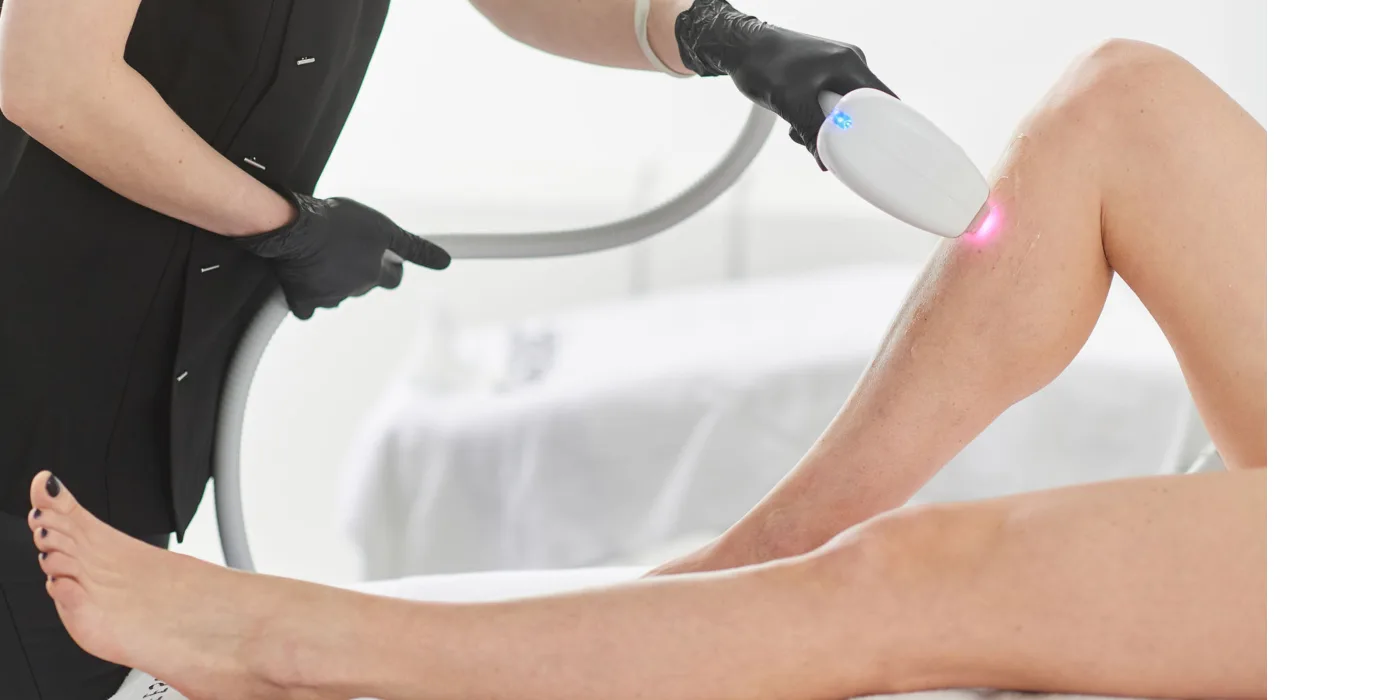
With a scanning laser, the client feels slight warmth. Afterwards: no tweezers, wax or epilator between sessions (shaving or depilatory cream are possible), sun protection as long as any irritation persists and no sunny holidays within two weeks. Some of the hairs fall out in the following days.
Side effects
On dense areas, redness and a sunburn-like sensation for one to two days. With a properly set laser, the risk of burns is very low.
Fine hair, white hair and moles
The laser has little effect on white hair and very light vellus hair; red hair remains difficult. In the case of a mole or suspicious lesion, do not treat and refer to a dermatologist.
Contraindications
Self-tanner, tan accelerator or depigmenting cream within the last 2 weeks, essential oils within the last week, wax or epilator within the last 4 weeks, sun 2 weeks before or after, pregnancy or planned pregnancy, vitiligo, psoriasis, eczema, dermatitis or skin cancer, isotretinoin and photosensitising medicines.
Areas to avoid
Genital mucous membranes, eyebrows (too close to the eyes) and tattoos.
Hormonal disorders
In cases of polycystic ovary syndrome or hirsutism, the result may not last beyond a few months. Inform your client before starting.
Dark skin
The 808 nm diode laser and the Nd:YAG are the safest technologies for higher skin types, provided the energy is delivered more slowly, in several passes at lower power.
Choosing the right device
Ask for demonstrations, ideally on yourself, and for references from clients you can contact. Check the lifespan and warranty, calculate the cost and time per area, and favour a large head (at least 14 x 14 mm) and scanning mode, which is as effective as and more comfortable than a single high-energy shot.