


Technology guide
Non-surgical facelift: alternatives to the scalpel
HIFU, radiofrequency, LED: how to redefine the facial contour and firm the face without surgery, which technology for which area, and what results to expect.
Definition
A non-surgical facelift refers to all the treatments that firm the skin and redefine the contours of the face using energy (ultrasound, radiofrequency, light), without incision. Results are gradual and more moderate than a surgical facelift, with no social downtime.
Which technology for which area
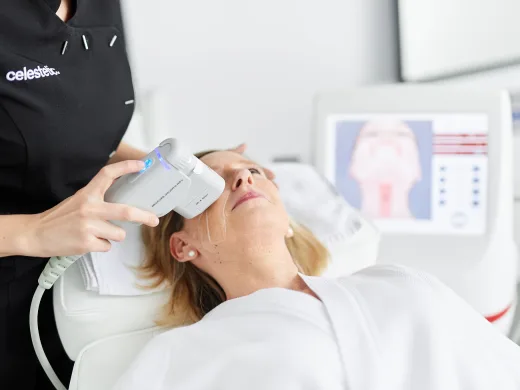
Cheeks, jowls and jawline are the areas of choice for HIFU, particularly at 3 and 4.5 mm to act on the SMAS. The neck responds well to HIFU and radiofrequency. The forehead and eye area require more caution. The décolleté, with its thin skin, lends itself well to radiofrequency and LED.
Choosing according to laxity
Marked laxity of the facial contour: HIFU at all three depths. Moderate laxity: HIFU complemented by a course of radiofrequency. Fine lines and texture: superficial HIFU or radiofrequency. Prevention and radiance: LED or light radiofrequency. Sensitive skin: LED.
What to expect
With HIFU, a slight tightening effect may appear quickly, but most of the result builds up over two to three months, with an optimal result around three months after the last session according to the manufacturer of the UltraLift III. Radiofrequency and LED progress session after session. An annual touch-up maintains the result.
The ideal client
Roughly between 30 and 65 years old, mild to moderate laxity, skin that is not too thin, realistic expectations and a willingness to follow the protocol and sun protection. Very significant laxity, excess skin or marked volume loss are more a matter for surgery or aesthetic medicine.
Contraindications
Pregnancy, infection or active herpes in the area, metal or electronic implants in the area (for HIFU and radiofrequency), severe photosensitivity. Poorly controlled diabetes, smoking, a tendency to keloids or very thin skin require caution and medical advice.