

Technology guide
Neocollagenesis: the natural production of new collagen
Firming treatments do not "make" collagen: they prompt the skin to produce it. Understanding this process explains why results build up over several months.
Definition
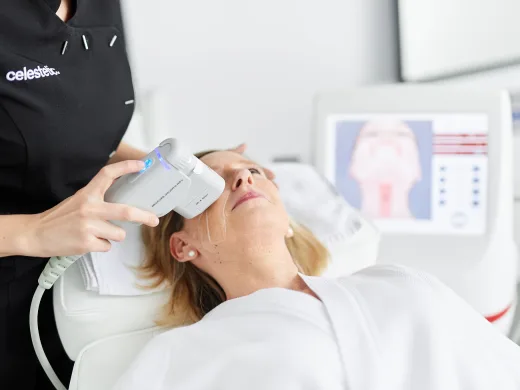
Neocollagenesis is the production of new collagen by the fibroblasts of the dermis, in response to thermal, mechanical or light stimulation. HIFU and radiofrequency create a controlled micro-lesion; LED activates cell metabolism.
Wound healing in miniature
After a micro-lesion, the skin goes through the natural stages of wound healing: a short inflammatory phase in which immune cells clean the area and send out signals, a phase in which fibroblasts multiply and produce collagen, then a long remodelling phase in which the fibres organise and consolidate.
Fibroblasts at work
At rest, fibroblasts quietly maintain the dermis. When stimulated, they change pace: they produce much more collagen for a few weeks, then gradually return to their normal activity.
Collagen I and III
New collagen initially contains a large proportion of flexible type III, then shifts towards a majority of stronger type I, as in normal skin.
The timeline of results
Immediately after the session, a slight tightening effect is possible, followed by temporary redness and swelling. Collagen production peaks within two to three weeks, improvement becomes visible over the following weeks and stabilises over several months. The new collagen then ages like the rest of the skin: a maintenance session prolongs the effect.
What influences the response
Age, genetics, smoking, poorly controlled diabetes, stress, lack of sleep, deficiencies (vitamin C, zinc) and sun exposure. A client who does not smoke, is well rested, well nourished and protected from the sun will respond better.