


Technology guide
Selective photothermolysis: the mechanism that destroys the hair
All laser hair removal rests on a principle published in 1983: heating a precise target without damaging what surrounds it. The three conditions that must be met and what makes them vary.
A founding principle
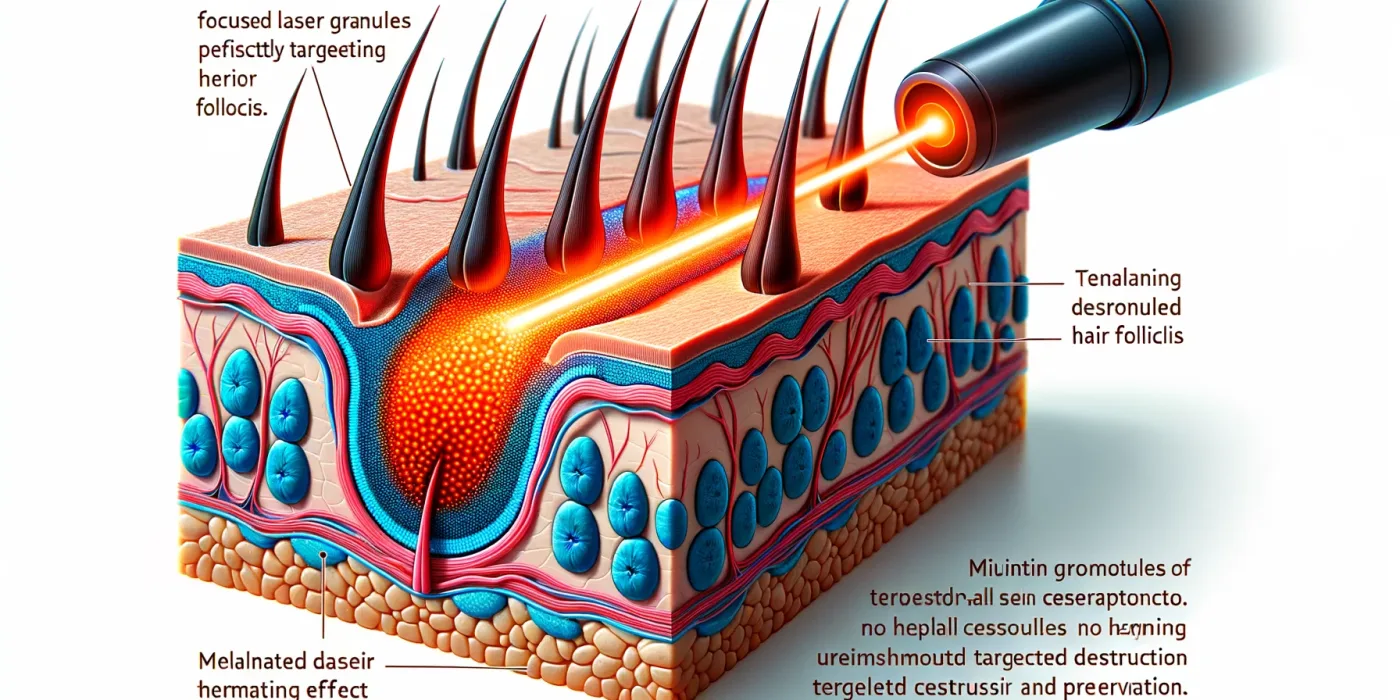
In 1983, Anderson and Parrish described selective photothermolysis in the journal Science. They showed that a precise pigmented target, such as the hair follicle, could be destroyed by heat by meeting three conditions.
Condition 1: the right wavelength
The light must be absorbed by the target, here the melanin in the hair, more than by the neighbouring tissues. This is "chemical" selectivity.
Condition 2: the right pulse duration
The pulse must be shorter than the time it takes for heat to escape from the target, known as the thermal relaxation time. Heat thus remains concentrated in the follicle. This is "thermal" selectivity.
Condition 3: enough energy
Fluence must be sufficient to bring the follicle to a temperature that irreversibly destroys the cells that produce the hair. Too little and nothing happens; too much and the skin burns.
What improves or degrades selectivity
It improves with a wavelength well absorbed by melanin, energy suited to the skin type and cooling of the epidermis. It deteriorates on very dark or tanned skin, and on fine or light hair, because the contrast between hair and skin decreases.
Why white hair resists
Without melanin, the hair absorbs almost no light: it does not heat up and the root survives. This is a limitation of all laser and intense pulsed light technologies.